Professional Crawl Space Mold Removal Gainesville, FL
Crawl space mold inspection and remediation for Gainesville homes. Licensed specialists serving Alachua County.
IICRC-Trained Technicians
Florida Licensed Remediator
Florida DBPR Licensed
Why Crawl Spaces Are a Common Mold Problem Here
A crawl space is a different environment from an attic, and it can develop mold for different reasons. While attics can trap hot, humid air, crawl spaces stay dark, have limited airflow, and sit close to the ground, making moisture from the soil and surrounding areas an important concern.
Gainesville’s warm, humid climate and local soil and drainage conditions can contribute to moisture problems in crawl spaces. Exposed soil, plumbing leaks, poor drainage, and inadequate moisture control can keep the space damp even when everything above ground looks normal.
Basements are less common in Florida than in many other parts of the country, while crawl spaces and slab foundations are common foundation types. Because crawl spaces are hidden below the living area, moisture and mold problems can continue for a long time before they are noticed.
We inspect and remediate crawl space mold for homes throughout Gainesville and Alachua County, with an approach built around identifying and correcting the moisture conditions contributing to the problem.
What Causes Crawl Space Mold in Gainesville Homes
Uncovered or exposed soil
A crawl space with bare dirt allows ground moisture to evaporate directly into the space below your home, contributing to consistently damp conditions.
Missing or damaged vapor barriers
A vapor barrier is a layer of durable material installed over the soil to reduce moisture entering the crawl space from the ground. Some older Gainesville homes may have no barrier or one that has torn, shifted, or deteriorated over time.
Poor crawl space ventilation
Vents are intended to provide airflow, but ventilation alone may not adequately control moisture in Florida’s humid climate. Depending on the property, additional moisture-control measures may be needed.
Plumbing leaks under the house
Supply lines and drain pipes that run through the crawl space can create concentrated moisture problems when they leak or remain damp for an extended period.
Standing water after heavy rain
Gainesville’s summer storms can contribute to water pooling in crawl spaces that have drainage problems or low areas around the foundation.
Damp wood framing
Floor joists and subflooring can develop mold when they remain exposed to excessive moisture. Because these materials are hidden underneath the home, problems may go unnoticed for a long time.
Signs You May Have Crawl Space Mold
Because crawl spaces are rarely inspected on a regular basis, moisture and mold problems can remain hidden for a long time before anyone realizes they are there.
Our Crawl Space Mold Removal Process
Inspection
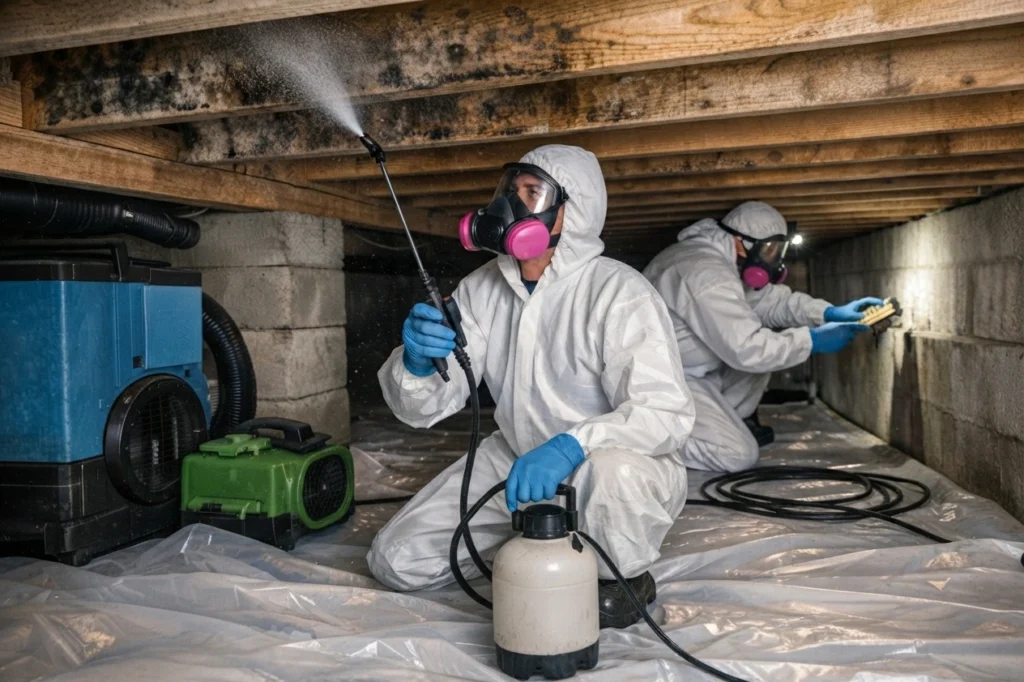
We physically access the crawl space to assess conditions directly, checking soil moisture, existing vapor barriers, plumbing, and the underside of floor joists for visible growth and moisture problems.
Moisture source identification
Before removal begins, we determine whether the issue is ground moisture, a plumbing leak, standing water, or a combination of factors. The appropriate solution depends on the cause.
Containment
Access points may be sealed and appropriate air-control measures used during active removal to help prevent mold particles from spreading into the living space.
Mold removal and material treatment
Contaminated wood surfaces are cleaned and treated with appropriate products when the material is structurally sound. Severely damaged wood is identified for repair or replacement.
Vapor barrier installation
For crawl spaces without a proper barrier, or with a damaged one, we can install durable vapor-barrier material over the soil to reduce ongoing ground moisture.
Drainage and moisture correction
If standing water or poor drainage is contributing to the problem, we address the underlying moisture issue rather than treating the mold alone.
Final inspection
We check moisture conditions and confirm that the affected area is dry and ready for the next stage of the work before considering the job complete.

Crawl Space Encapsulation as a Longer-Term Fix
For crawl spaces with chronic moisture problems, a ground vapor barrier alone may not be enough. Encapsulation involves sealing the crawl space, covering the floor and walls with durable vapor-barrier material, and sealing vents and other openings. Depending on the conditions, a dehumidifier may also be used to help manage humidity inside the space.
This is a larger investment than a standard ground vapor barrier, but for homes with recurring moisture problems, encapsulation can provide more comprehensive moisture control than relying on ventilation alone.
We can assess whether a standard vapor barrier or full encapsulation makes more sense for your specific property as part of the inspection.
Crawl Space Mold Removal vs. Encapsulation
Mold removal addresses existing mold growth, while crawl space encapsulation focuses primarily on controlling the moisture conditions that can contribute to future problems.
Depending on the condition of the crawl space, a property may need mold remediation, moisture correction, encapsulation, or a combination of these services. Addressing the moisture source is important because simply cleaning visible mold without correcting the underlying conditions may allow the problem to return.
Confined Space Considerations
Crawl spaces present their own set of challenges separate from an attic. They are typically low clearance, dark, and can have limited entry and exit points. Our technicians use appropriate protective equipment and follow safety procedures for working in low-clearance, restricted-access areas.
This type of work can involve tight spaces, damp conditions, exposed insulation, wiring, plumbing, and other potential hazards, which is why professional assessment and appropriate equipment are important.
Why Choose Us
We are based at 1008 NW 13th St and have worked on crawl space mold issues across Alachua County, from older homes near downtown to newer properties near Haile Plantation.
Our technicians hold IICRC certification, and we carry the appropriate Florida DBPR mold remediation license for the work we perform. Florida has specific licensing requirements for mold-related services, including requirements that may apply to remediation involving more than 10 square feet of mold contamination.
We have completed more than 600 residential and commercial projects since 2020. We assess the actual moisture source in your crawl space rather than applying a generic fix to every property.
Areas We Serve
We provide crawl space mold removal throughout Gainesville and surrounding areas across Alachua County, including:
We also serve nearby communities including Alachua, High Springs, Newberry, Archer, Hawthorne, Micanopy, and Waldo.
Frequently Asked Questions
Call to Action
If you have noticed a musty smell, damp conditions near your floors, or have not checked your crawl space in years, call for an inspection before a hidden moisture problem gets worse.