Professional HVAC Mold Remediation & Removal Gainesville, FL
HVAC and air duct mold remediation for Gainesville homes and businesses. Licensed specialists serving Alachua County.
IICRC-Trained Technicians
Florida Licensed Remediator
Florida DBPR Licensed
Why Mold in Your HVAC System Is Different
Mold in a bathroom or closet generally stays in one area until it is disturbed. Mold inside an HVAC system is different because the system moves air through ductwork and into connected rooms, making the location of the contamination important to investigate.
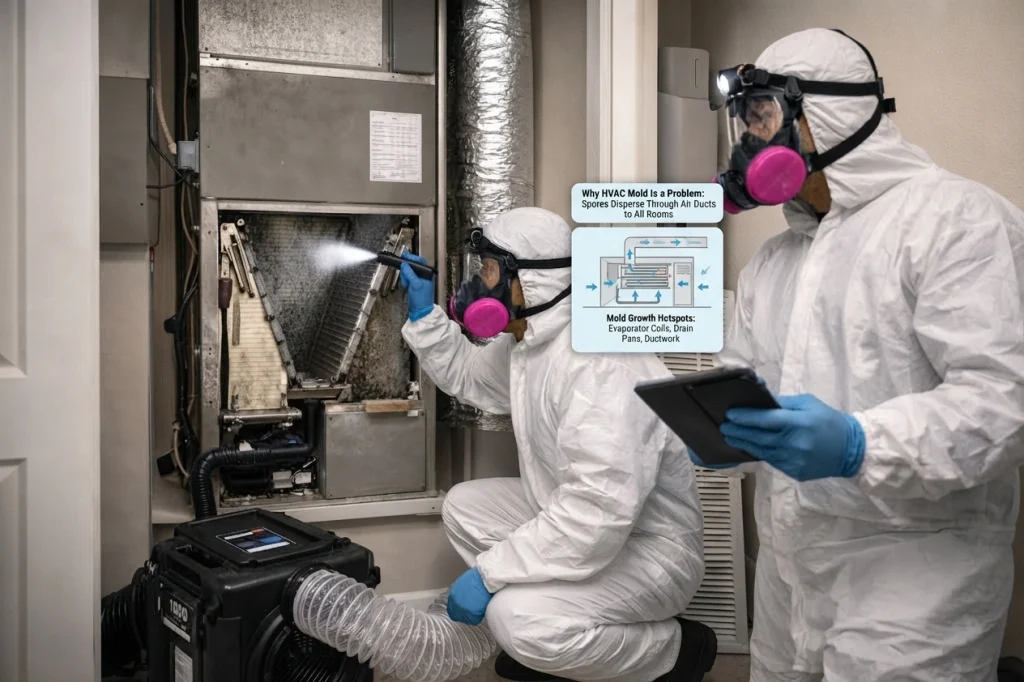
Air conditioning systems can create conditions that support mold growth when moisture is not properly controlled. As an HVAC system cools warm, humid Gainesville air, condensation forms on the evaporator coil and collects in a drain pan. If the pan does not drain properly, or if moisture accumulates on or around ductwork, the system can develop damp conditions where mold may grow.
We handle HVAC mold assessment and remediation for homes and businesses throughout Gainesville and Alachua County, while also looking at the moisture and airflow conditions that may have contributed to the problem.
Duct Cleaning and HVAC Mold Remediation Are Not the Same Thing
This distinction matters because duct cleaning and mold remediation address different problems. Standard air duct cleaning, such as cleaning performed according to NADCA guidelines, focuses on removing dust, debris, and buildup from ductwork.
Active mold growth inside an HVAC system, particularly on the evaporator coil, in the drain pan, inside the blower compartment, or on duct insulation, requires a different approach. The moisture source needs to be evaluated, and depending on the extent and location of the contamination, additional remediation may be necessary.
We explain which situation applies to your system rather than automatically recommending mold remediation when standard HVAC cleaning or maintenance may be sufficient.
Where HVAC Mold Is Most Commonly Found
Mold concerns in HVAC systems can involve several different components. Common areas to inspect include the air handler, evaporator coil, condensate drain pan, blower compartment, accessible ductwork, and duct insulation.
The exact location matters because cleaning one component without addressing the underlying moisture source may not solve the problem. An inspection helps determine where the growth is located and what conditions allowed it to develop.
What Causes HVAC Mold in Gainesville Systems
Signs Your HVAC System Has a Mold Problem
A musty odor that becomes noticeable specifically when the HVAC system turns on can be a reason to have the air handler, drain pan, and accessible ductwork inspected.
Our HVAC Mold Assessment and Remediation Process
Inspection
We assess the air handler, evaporator coil, drain pan, blower compartment, and accessible ductwork to determine the location and extent of any suspected contamination.
Source identification
We determine what allowed moisture to accumulate, whether that involves a drain line, drain pan, coil, ductwork, or another source. Addressing the cause is an important part of a lasting solution.
Containment for active removal
When confirmed mold growth requires remediation, affected areas may be isolated and appropriate air-control measures used to help prevent contamination from spreading through the HVAC system and into occupied rooms during the work.
Cleaning and treatment
HVAC components and accessible surfaces are cleaned using methods and products appropriate for the material and application. Where treatment products are used, they are selected according to their intended use and product labeling.
Component repair or replacement
If a drain line, drain pan, insulation, or another component is damaged, necessary repairs or replacement may be recommended. Cleaning alone cannot correct an ongoing mechanical or moisture problem.
System verification
We check that the system is draining properly and that moisture conditions have been addressed before considering the work complete.

Why This Matters More During Gainesville Summers
Gainesville’s warm and humid climate can place a significant moisture load on air conditioning systems during the summer. As HVAC systems operate more frequently, problems involving condensate drains, drain pans, insulation, and humidity control can become more noticeable.
Regular HVAC maintenance, including checking the condensate drain and drain pan, can help identify developing moisture problems before they become more serious.
Why Choose Us
We are based at 1008 NW 13th St and have assessed HVAC mold concerns across Alachua County, including residential systems and larger commercial units serving offices and rental properties near campus.
Our technicians hold IICRC certification, and we carry the appropriate Florida DBPR mold remediation license for the work we perform. Florida has specific licensing requirements for mold-related services, including requirements that may apply to remediation involving more than 10 square feet of mold contamination.
We have completed more than 600 residential and commercial projects since 2020. We tell you clearly whether your system needs standard duct cleaning, HVAC maintenance, or actual mold remediation rather than automatically recommending the more expensive option.
Areas We Serve
We provide HVAC mold assessment and remediation throughout Gainesville and surrounding areas across Alachua County, including:
We also serve nearby communities including Alachua, High Springs, Newberry, Archer, Hawthorne, Micanopy, and Waldo.
Frequently Asked Questions
Call to Action
If your home develops a musty odor when the AC runs, you notice moisture around the air handler, or you are concerned about possible mold inside your HVAC system, call for an inspection to identify the source and determine the appropriate next step.